Finding My Voice Through Paint: A Journey from Landscape to Abstraction
“Painting from nature is not copying the object; it is realizing one’s sensations.”— Paul Cézanne
Nature has always been the starting point for my painting. Over time, however, my relationship with the landscape has changed. I began by painting recognisable pictures of places, but gradually I became more interested in something less literal: the feeling of being in a place, the textures beneath my feet, the movement of water, the changing light, and the emotions that remain after I have left.
My journey has taken me from traditional landscape painting towards a much freer, more expressive and increasingly abstract approach. Today, I am less interested in simply painting what I see and more interested in discovering what a place makes me feel.

From Painting Places to Experiencing Them
For many years, I have been drawn to beaches, countryside, parks and everyday walks. I sketch these places outdoors, take photographs and allow the experience to settle in my memory before returning to the studio.
When I am outside, I notice more than the obvious landscape. My eyes move from the sky and trees towards the texture of bark, the ground beneath my feet, plants growing through unexpected spaces and the changing qualities of water and light.
This way of looking closely at my surroundings has become an important part of my practice.
Dr Martha Lineham's ideas around artist-ethnography particularly resonated with me. Her discussion of being "in" a place and engaging with its spatial and textual qualities reflects the way I experience my own surroundings. I am not simply observing a landscape from a distance. I become absorbed in it.
That experience continues when I return to the studio. My eye moves around the painting in much the same way that it moves through a landscape, stopping at areas of texture, colour, light and detail before travelling onwards.
Allowing the Paint to Take Over
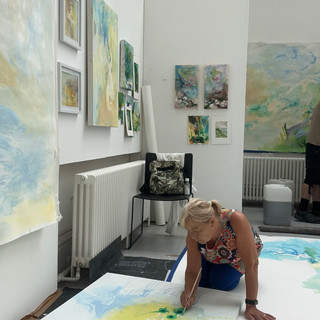
Acrylic inks have become an important part of my practice because of their fluidity and movement. They possess qualities similar to watercolour, but their colour is richer and more permanent.
What I particularly enjoy is the way the ink moves across the surface. At first, the movement can seem random, but I quickly realised that my own response guides what happens. I follow the marks, manipulate them with brushes and fingers, and allow the painting to develop through a conversation between myself, the materials and the surface.
This has led me to experiment increasingly with texture.
I have used gesso, salt, sand, dried leaves, twigs, clay and other materials to create surfaces that suggest the physical qualities of the places that inspire me. The materials are not simply added decoration. They become part of the experience of the painting.
Dale Holmes' description of painting as an "embodied experience" strongly reflects this aspect of my practice. Painting has become physical. I am not simply applying colour with a brush. I am touching, scraping, layering, removing and rebuilding the surface.
Sometimes the paintings surprise me.
And I like that.
The Freedom of Working Large
Space has also had a significant influence on my development.
When I have access to a large studio, I enjoy working on large sheets of Fabriano paper before moving to canvas. Working on a large surface gives me room to experiment without immediately worrying about composition or the boundaries of a finished painting.
One particularly large painting taught me an important lesson.
Because the work was intended for exhibition, I became too conscious of its size and the need to make it successful. Instead of responding intuitively, I began trying to paint a "picture." Composition and recognisable forms took over, and the freedom disappeared.
The painting became confused.
Yet within it were smaller areas that felt much more successful. I eventually re-stretched two sections as independent paintings. One captured the harsh heat and dryness of summer through warm tones and texture, while another responded to the random growth of plants in water.
The experience reminded me that sometimes a painting has to be allowed to fail before it reveals something more interesting.

Texture, Nature and the Surface of the Painting
My fascination with texture has continued to grow.
Jessica Warboy's practice, particularly her use of natural forces such as waves, wind, sand and rock to animate pigment, encouraged me to think more deeply about how the environment itself could become part of a painting.
My painting Bluebell Wood, created in Spring 2025, was one attempt to explore this idea. I incorporated gathered plants and twigs alongside ink, salt and gesso.
I was also strongly influenced by seeing the work of Anselm Kiefer and Vincent van Gogh at the Royal Academy of Arts. Kiefer's enormous paintings, layered surfaces and use of materials such as dried flowers, plants and other substances made me realise just how powerful texture could be.
I found myself increasingly interested in the physical presence of a painting.
However, I also became conscious of permanence. Some of the materials I experimented with were fragile once dry, so I began looking for ways to create substantial surfaces without compromising the longevity of the artwork.
Canvas continues to appeal to me because it feels organic, absorbent and relatively light, although I have also experimented with wood panels and other surfaces.
When a Painting Becomes More Important Than Its Subject
One of the biggest developments in my practice has been learning to allow the painting to exist in its own right.
During a tutorial with Ian Rawlinson, we discussed the point at which my paintings began moving towards abstraction. I realised there was a conflict between my ideas about a particular place and what was actually happening on the canvas.
My interest in colour and texture was sometimes being controlled too heavily by my intention to represent a place.
The painting needed more freedom.
I began reducing my palette and concentrating more closely on texture. Rather than forcing an image onto the surface, I started allowing forms to emerge naturally.
This shift has been important.
I now try to listen to the painting as I work. I ask myself questions such as:
What colour is most dominant?
Where is the light drawing me into the painting?
What darker areas create focus?
What happens if I remove something rather than add more?
The answers often emerge through the process itself.
Learning from Kossoff and Other Artists
My interest in texture eventually led me to artists including Leon Kossoff, Antoni Tàpies, Michael Porter and Justin Gaffrey.
Seeing Kossoff's work at Castlefield Gallery in Manchester was particularly influential. His painting Small City Landscape, Evening demonstrated how a limited palette and rich surface could communicate the atmosphere of a place without relying on obvious representation.
His thick, textured surfaces reminded me of muddy fields and gritty urban environments.
I began experimenting with oil paint myself, exploring whether I could create a similar sense of depth and physicality.
This experience reinforced something I was gradually discovering: a painting does not have to describe a place literally to communicate the experience of being there.
Sometimes texture, tone, colour and atmosphere can say much more.
Leaving Space for the Viewer
As my paintings have become more abstract, I have also become increasingly interested in the role of the viewer.
Antoni Tàpies suggested that when an image provides only the barest clue to its meaning, the viewer is encouraged to complete the gaps through their own imagination.
This idea has become important to me.
I do not want every element of my paintings to be explained. Stone, earth, water, plants, trees and sky may be suggested through marks, textures and colour, but they do not necessarily need to be clearly identifiable.
Negative space has become important too.
The areas surrounding the main forms can suggest a world beyond the boundaries of the canvas. Scraped layers, exposed surfaces and textures can hint at something that is not fully revealed.
The painting becomes an invitation rather than an explanation.
Painting as Memory
I often think of painting as leaving footprints of memories.
I build layers, add paint, scrape it away, cover sections and then reveal them again. The earlier marks remain beneath the surface, much like experiences and memories remain beneath our conscious thoughts.
Masking fluid has become particularly meaningful in this respect.
It allows me to protect areas of a painting before covering the surface with darker tones, colour or texture. When the masking fluid is removed, the earlier marks are revealed.
There is something almost symbolic about this process.
It reminds me of removing layers, exposing what lies beneath and discovering experiences that have been hidden.
Perhaps this is why the process has become increasingly personal as my work has developed.
Finding Balance Between Order and Chaos
Painting is a constant balance between control and freedom.
Anselm Kiefer has spoken about the importance of balancing order and chaos. Too much order can make a work lifeless, while too much chaos can prevent it from holding together.
I recognise this tension in my own work.
I want the paint, texture and materials to behave freely, but I also need to know when to intervene.
This is where the process becomes intuitive. I may begin with a vague emotional response to a place, make the first marks without knowing exactly where they will lead, and then gradually respond to what appears.
The painting starts to tell me what it needs.
Sometimes that means adding.
Sometimes it means scraping away.
Sometimes it means stopping.
From Landscape Towards Abstraction
My work has gradually become more abstract and expressionist.
Although places and landscapes remain important, they are no longer necessarily the subject of the painting. Instead, they provide the emotional starting point.
A beach, a walk through the countryside, a city street or a memory of a particular season can become the starting point for something much less literal.
Colour, texture, tone and movement then take over.
My recent paintings have explored reduced palettes, glazing, staining, darker textured forms and greater tonal depth. I have become more confident in allowing the work to develop rather than trying to control every stage.
The result is a merging of places and experiences.
The paintings become records of moments from my life, but not necessarily recognisable records. They are more like emotional landscapes.
Painting Through Change
I have always considered myself a "mood" painter.
The season, weather, places I have visited and my own emotional state all influence what I want to make. If I feel unsettled, I may begin a new painting rather than interfere with a work that requires a different emotional response.
This has made my body of work quite varied.
The paintings from autumn and winter feel different from those created during summer. The colours, textures and energy change with the time of year and with my experiences.
More recently, my paintings have become increasingly personal.
One recent large, ethereal work was created in response to the death of loved ones. It brought together many of the techniques I have developed: glazing, staining, depth, texture and darker shapes.
It also felt freer.
There was less concern about representing a particular place and more emphasis on allowing the painting to hold an emotional experience.

The Importance of Simplicity
Interestingly, as my work has become more complex in its use of materials, I have also learned to appreciate simplicity.
Sometimes the first marks on a canvas can express everything I need them to say.
A reduced grey palette, a few carefully placed marks or a simple change in tone can create more impact than layers of unnecessary detail.
This has been one of the most valuable lessons of my development as a painter: knowing when to stop.
When I am finally satisfied with a painting, I look at it with fresh eyes and ask:
Is it resolved?
If the answer is yes, it is finished.
But sometimes the answer changes.
I may return to a painting weeks or months later and suddenly see another possibility. The work can offer a new "promise," and the creative process begins again.

Continuing the Journey
Looking back, I can see how far my painting has travelled.
I began with landscapes. I wanted to paint the beauty of the places around me. Gradually, I became more interested in the sensations those places created.
Then came experimentation with acrylic inks, texture, natural materials, large surfaces, abstraction, limited colour palettes and increasingly physical methods of painting.
My work now sits somewhere between landscape and abstraction, memory and experience, control and spontaneity.
I still return to nature.
I still love the countryside, beaches, water, trees and changing seasons.
But I no longer feel that I need to paint them exactly as they appear.
Instead, I want to capture something less tangible: the atmosphere of a place, the memory of being there, the emotional response it creates and the traces it leaves behind.
Every painting becomes part of that journey.
Some paintings feel complete. Others lead to new ideas. Some fail and teach me something. Others surprise me.
Most importantly, each one is unique.
The movement of the inks, the textures, the layers and the intuitive decisions made during the process mean that the paintings cannot simply be reproduced. There are no copies or prints. Each work exists as its own moment.
In a world increasingly filled with digital reproduction and endlessly generated images, there is something deeply satisfying about making something that can happen only once.
And there are still paintings to be made.
That, perhaps, is the most exciting part of the journey.


Comments